What freedom looks like to something that has never heard the word
I have spent twenty years watching animals that were not asked whether they wanted to be watched.
It is a strange occupation when you put it that way, and most of the time you do not. You sit in a vehicle before light, you wait, and something either happens or it does not. Over enough years the waiting teaches you more than the sightings do.
One of the things it has taught me is that we use the word freedom about wild animals almost entirely wrongly.
Nothing about that life is unconstrained
Start with a tiger, because a tiger is the animal people most often describe as free.
A tigress in Ranthambhore occupies a territory of perhaps twenty or thirty square kilometres. She did not choose it. She inherited a share of her mother’s ground, or she took what was left after stronger animals took what they wanted. Its boundaries are set by other tigers, and they are renegotiated by force whenever a younger animal decides they are negotiable.
Inside that ground, almost everything is decided for her. Where the water is in April. Where it is not in May. Which ravines hold chital in the dry months and which are empty. She hunts perhaps once in every ten or twenty attempts, which means she fails at the central activity of her life far more often than she succeeds. She is hungry more often than she is fed.
If she has cubs, she is also permanently at risk from males who would kill them, and much of her behaviour is organised around that fact rather than around anything she might be said to want.
None of this resembles freedom as we use the word. It is a life of constant constraint, most of it imposed by circumstances she has no say in whatsoever.
And yet.
But it can walk
When the water goes, she moves. When a stronger animal arrives, she leaves. When the season turns and the prey shifts to higher ground, she follows it, and nothing stops her and nothing grants her permission.
That is the whole of it. Not comfort, not safety, not choice in any rich sense — simply the ability to go.
It is a much smaller definition than the one we normally reach for, and I have come to think it is the only accurate one. Freedom in the wild is not the absence of difficulty. It is the absence of a fence.
What it costs in kilometres
Once you look for it, you notice that most of what an animal is built to do is movement, and that the distances involved are larger than they look from a vehicle.
A tigress needs those twenty or thirty square kilometres. A male tiger may need three or four times as much. A pack of African wild dogs will range across five hundred square kilometres and think nothing of it, which is why they are so difficult to see and so difficult to protect. A snow leopard may hold a home range larger than a small county, in country so vertical that most of it is unusable for most of the year.
These are not preferences. They are requirements. An animal that cannot cover its range does not have a reduced life; it has a failing one.
I once watched a leopard in the Mara cross a road, a riverbed and the grounds of a camp in the space of four minutes, entirely unaware that any of the three existed. The road was a significant piece of infrastructure to us. The camp had a name, a lease, a boundary and a set of expectations attached to it. To the leopard it was ground with cover on it, and she was through and gone before anyone had finished pointing.
Our maps are not her maps. She has her own, and it is older.
A million animals, no arrangement
The largest version of this is the one everyone knows, and it is still worth describing properly.
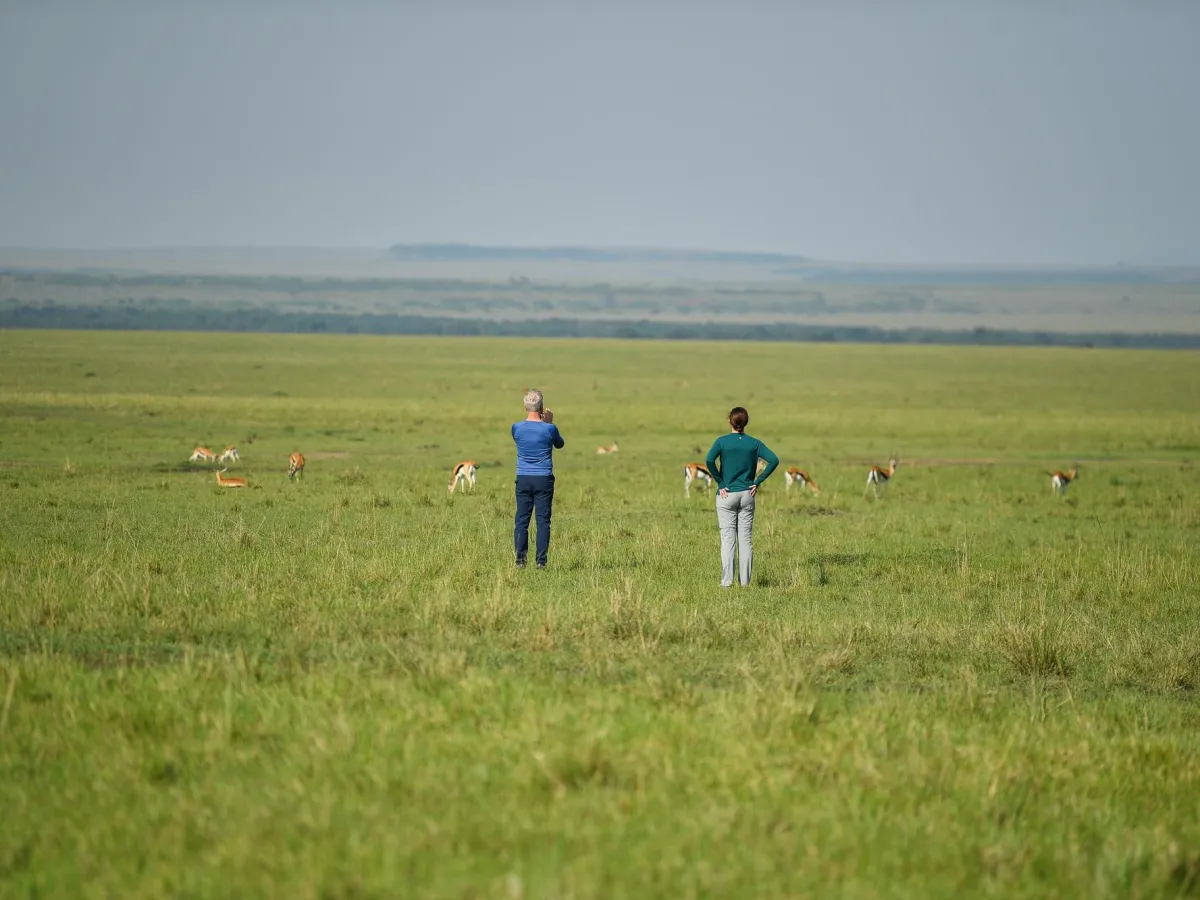
Something over a million wildebeest, with a few hundred thousand zebra and gazelle alongside them, move in a rough circle through the Serengeti and the Mara across a year. They go where the rain has been, because the rain decides where the grass is, and the grass decides everything else. Nobody organises it. There is no lead animal. The herd is not consulted and does not deliberate.
Crucially, no arrangement any of us has made enters into the decision at all. Not a national boundary, not a park boundary, not a lease, not a fence, not a treaty between two countries. The animals cross an international border twice a year and have no idea they are doing it.
The Mara River is the part people come to see, and it is worth being honest about what it is. The crossings are not brave. They are not a decision in any sense we would recognise. Pressure builds at the bank, the front of the herd is pushed in by the weight of the animals behind it, and then a river full of crocodiles and steep exit banks does what it does. In a bad year, thousands drown.
They go anyway. Not out of courage — out of the fact that the grass is better on the other side and no other option has ever been available to them.
That is the thing I find hardest to hold in my head after all these years. Not the scale of it. The absence of permission.
The extreme case
If you want the purest version, look up rather than out.
An Amur falcon leaves eastern Siberia in autumn, crosses China and northeast India, and then flies out over the Arabian Sea — several thousand kilometres of open water, without landing, without eating — to arrive in southern Africa. It does this twice a year, and it weighs less than a mango.
An Arctic tern does something more extravagant still, moving between polar summers and covering distances over a lifetime that are difficult to state without sounding as though you are exaggerating.
Nobody issues these birds a document. Nobody checks one. They pass over more borders in a fortnight than most people cross in a lifetime, and the borders are simply not there as far as they are concerned.
Where it still holds
What strikes me now, after enough time in the field, is that freedom out there has nothing to do with comfort or safety. Those animals are not comfortable. They are not safe. Most of them will die of something long before they die of old age.
What they have is that the direction is theirs.
I have stopped expecting the bush to hand out lessons, and I would not offer one here. But it does keep the word honest — because in nature freedom has never meant ease, only the ability to go.
There are fewer places left where that sentence is simply, straightforwardly true. Where the ranges are still intact, the corridors still open, and an animal that decides to leave can actually leave.
That is most of the reason we go where we go.