The mountain gorilla lives in just a few countries in central and eastern Africa: Rwanda, Uganda and the Democratic Republic of the Congo. These are countries of mountainous forest with a warm, humid climate for much of the year, and their forests are full of birds, mammals and insects. Gorilla treks are among the main draws for visitors. The world’s entire mountain gorilla population is only just over 1,000 animals, split between the Virunga volcanoes, shared by Rwanda, Uganda and the DRC, and the Bwindi forest in Uganda, which holds around 459 of them. This article is a closer look at the species; if you are planning a trek, see our gorilla trek FAQ.
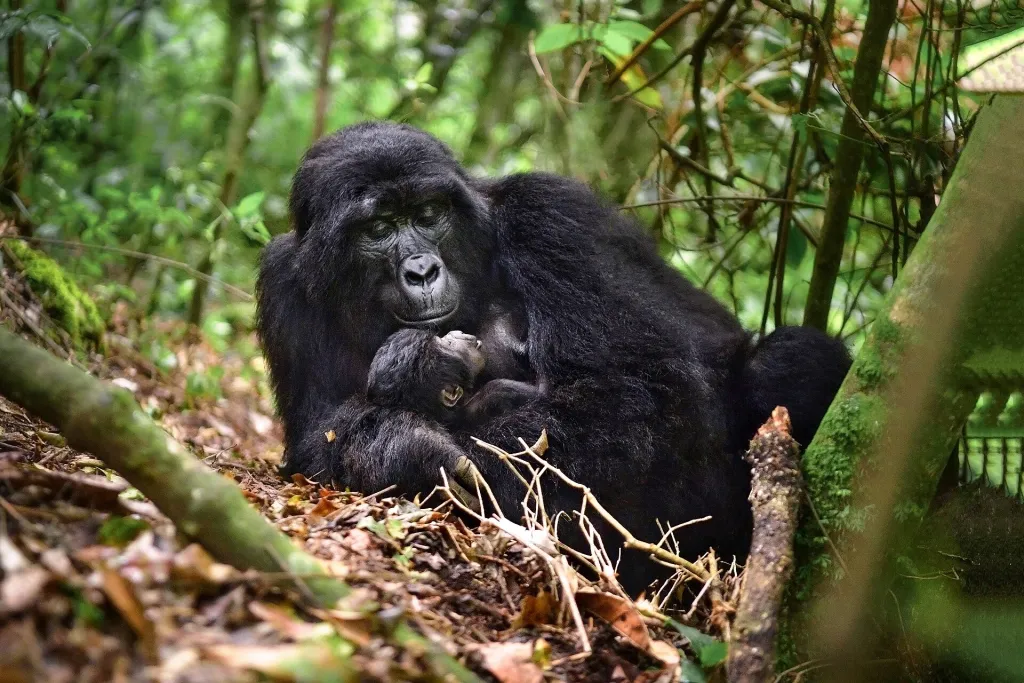
Gorilla cub
A distinct subspecies
Mountain gorillas differ from the eastern lowland gorillas, shaped by where they live. They have thicker skin and longer fur to cope with the cold of the high mountains, with shorter hair on the back and almost none on the hands, feet and ears. They have large bodies, long arms, a round belly, a narrow chest and a long skull, and are said to have a larger brain than the other gorillas. Their powerful jaws let them eat the tough plants of the mountains, and their efficient digestive system accounts for their prominent belly. An adult male stands about 1.5 metres tall and weighs around 190 kilograms; an adult female is about a metre tall and around 100 kilograms.
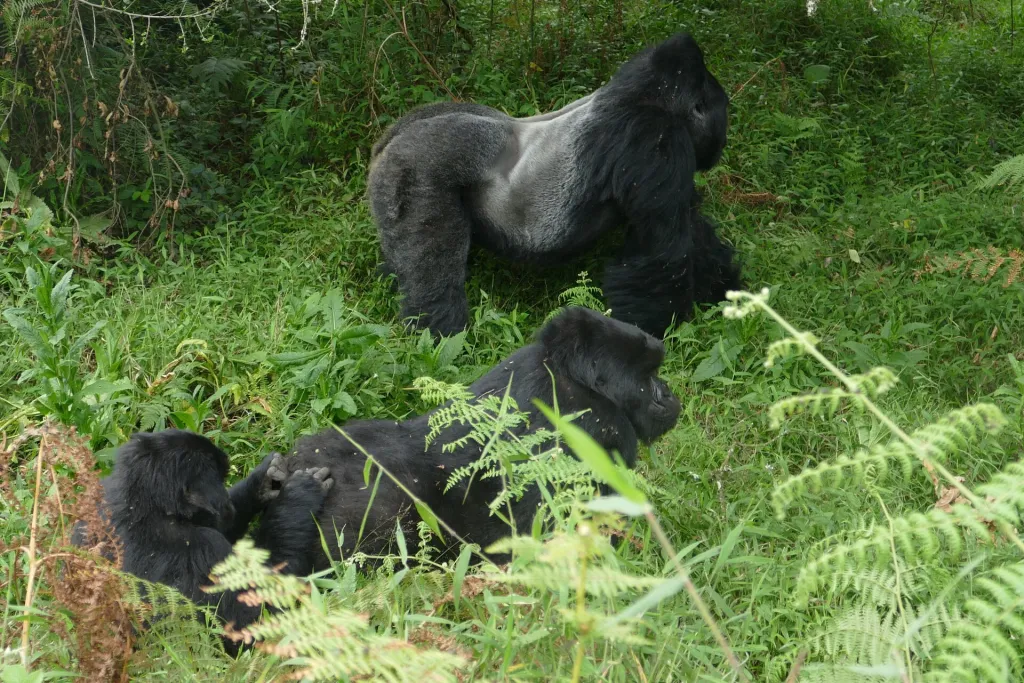
Gorilla family
Feeding
Mountain gorillas feed much like other gorillas. They are largely herbivorous, living on leaves, stems, bark, flowers and buds, with the odd ant, snail, slug or grub. They can feed on as many as 142 plant species, though the limited variety in their habitat means leaves and other greenery make up about 85 per cent of the diet, alongside plants, insects and roots. An adult can eat around 30 kilograms of food a day, and a female up to about 18 kilograms; they get most of their water from the plants they eat.
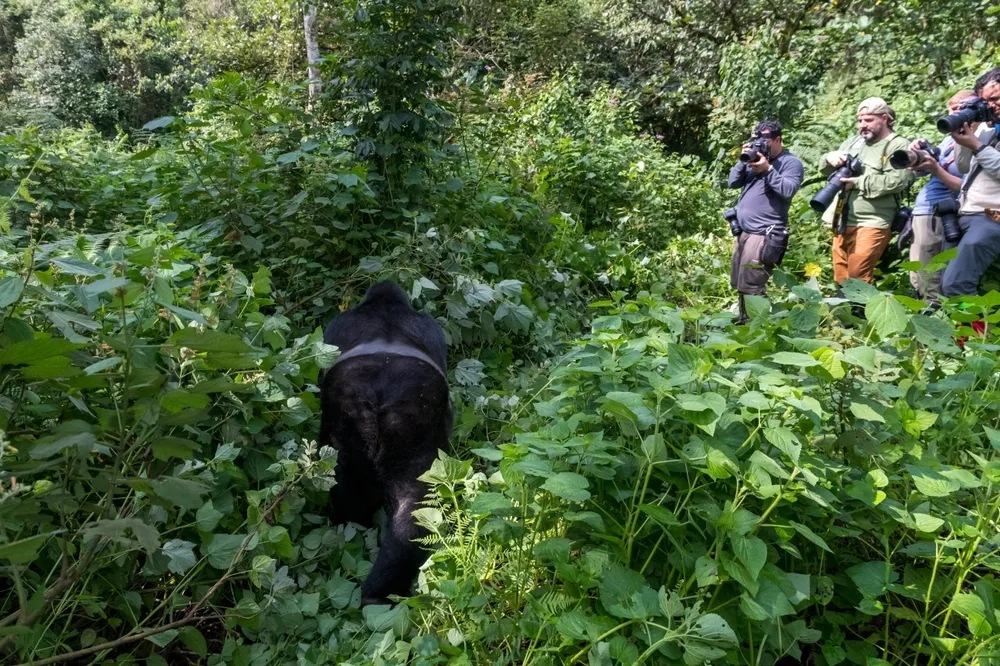
Gorilla and its admirers
Social life
Contrary to their reputation, mountain gorillas are peaceful, social animals that live in a family-like group. A dominant male, the silverback, leads the group and takes charge, along with subordinate males and females with their young. The silverback also defends the group against intruders and predators.
The females are not especially bonded to one another; each focuses on caring for her infant and staying close to the silverback for protection. When the group moves, males, females and young all help build nests, gather food and set up a place to rest. And though the adults are not closely bonded, they do look out for one another: if a mother dies, her infant is not abandoned but cared for by the group, a strikingly human side to these animals.

Mountain Gorilla
Where they live
Mountain gorillas are found in the forests of the Albertine Rift and the Virunga mountains, including Bwindi Impenetrable National Park, Virunga National Park, Volcanoes National Park and Mgahinga Gorilla National Park. They live in dense tropical forest at altitudes of up to around 4,000 metres, and are also found on the fertile slopes of the Bisoke and Mikeno volcanoes.
Sadly, the mountain gorilla is an endangered species, the result of poaching, disease and habitat loss. Continued conservation is vital to protect these rare and remarkable animals.