Seeing a tiger moving freely in the wild is a thrilling thing. But you need a fair bit of luck to spot these elusive cats, and wildlife lovers often ask how to improve their odds. This article is for them.
Start with a simple idea: probability over many attempts. If a park gives you, say, a 20 per cent chance of a sighting on any one safari, a single drive is all or nothing — you either see a tiger or you don’t. But over many drives, those odds play out: across a hundred attempts, you would expect to see one on roughly twenty of them. The more times you go out, the better your overall chances. Remember, this is a wild, uncontrolled setting, and no one can promise a sighting. Here is how tigers are tracked in Indian parks.
How tigers are tracked in the jungle
- Alarm calls: prey animals such as langurs, spotted deer and sambar give a distinctive call to warn the herd when they see a tiger. When we hear these calls, it is fairly certain a predator is about.
- Pugmarks: fresh tiger pugmarks on the track tell us the animal has passed this way recently, and we follow the trail while staying on our designated route.
- Word from other jeeps: if another jeep spots a tiger or hears alarm calls, its guide usually passes the word on. In India, though, drivers do not have radios as they do in some African parks; only forest officials are allowed to carry them.

What improves your chances
- The park itself: tiger numbers and density vary from park to park. If you go to the Sundarbans or Thekkady with a tiger as your only aim, you are likely to be disappointed. Some of the best parks for tigers in India right now are Tadoba Andhari Tiger Reserve (Maharashtra), Bandhavgarh National Park (Madhya Pradesh), Ranthambhore National Park (Rajasthan), Kanha National Park (Madhya Pradesh) and Jim Corbett National Park (Uttarakhand). In some places tigers are plentiful but hard to see because the terrain makes tracking difficult; the Sundarbans is one such example.
- Time of year: summer can improve your chances. As smaller waterholes dry up, tigers roam in search of water and often come to a lake or stream. Some parks have artificial waterholes, and jeeps usually take you near water, which makes tigers easier to spot. The trade-off is the heat, which can be fierce in some northern and central parks.
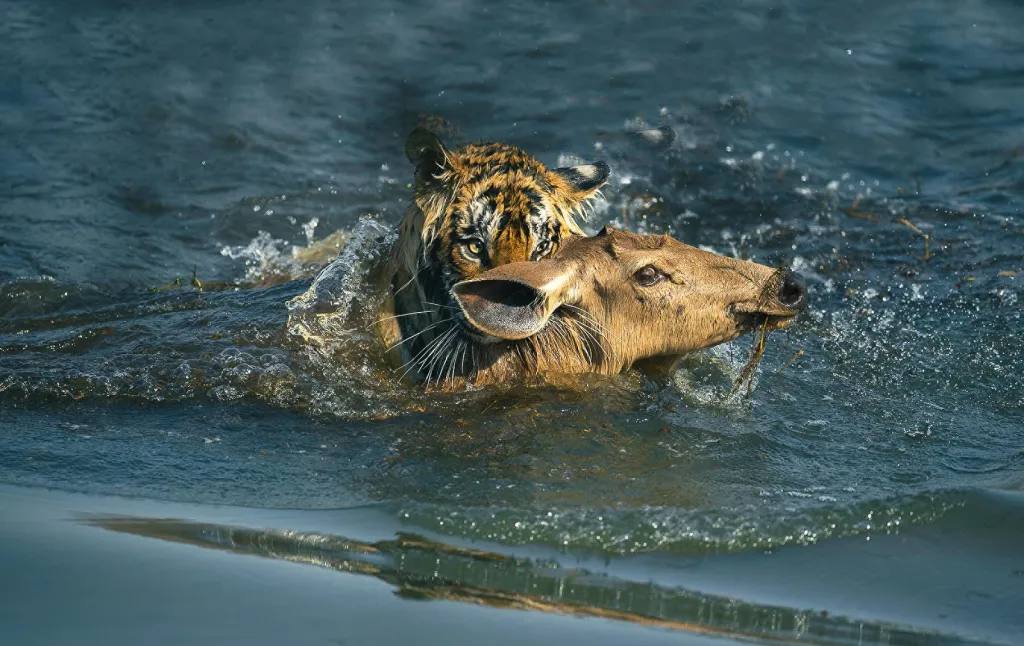
- Near a kill: after a big kill such as a sambar, a tiger takes four or five days to finish it. So if a tiger was seen at a kill the day before your visit, there is a good chance it is still in the area, returning to feed until the carcass is gone.
- Zone of the park: most large parks are divided into zones, and a safari vehicle can usually enter only one zone per drive. There are exceptions — at Tadoba, for instance, only your entry gate is fixed and vehicles can move throughout the park. Animals, of course, ignore these boundaries, but some zones simply offer better chances than others.
- Your guide’s skill: this is one of the most important factors. Nothing makes for a better safari than a skilled naturalist. With years of experience, a good guide can make the drive worthwhile even when you do not see a tiger.
What reduces your chances
- Rain, that day or the day before: with water everywhere, tigers are more likely to stay put and are harder to find.
- A tigress with small cubs: she tends to stay in one place for the first few months, and the cubs are rarely seen by tourists.
- No sightings the previous day: there are stretches when tourists do not see tigers for days. Ask locals or your naturalist how the recent sightings have been.
We hope this helps anyone keen to see a tiger. But our honest view is this: while spotting a tiger is a real thrill, especially for first-timers, a jungle is full of other creatures just as worth seeking. Go with an open mind, enjoy the wilderness as it unfolds, and who knows, you may just find a tiger among the trees.